
Hedges enclosed cottage gardens
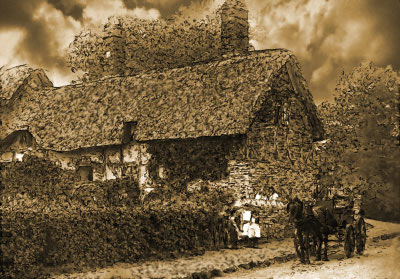 The
traditional cottage garden had to be enclosed by a fence, hedge, or
wall to prevent wandering sheep from eating up the plants. Of
these three options, a hedge
was the most traditional enclosure since it was cheap and relatively
easy to create. A well developed hedge kept livestock and wind
out of the garden with ease.
The
traditional cottage garden had to be enclosed by a fence, hedge, or
wall to prevent wandering sheep from eating up the plants. Of
these three options, a hedge
was the most traditional enclosure since it was cheap and relatively
easy to create. A well developed hedge kept livestock and wind
out of the garden with ease.
Traditional British
hedges often contained a mixture of native trees,
roses, hazelnuts, blackberries, forsythia, quince, damsons, and
hawthorns. Christopher Lloyd noted that hedges did double-duty,
both keeping out unwanted livestock and providing edible plants without
taking up valuable garden space. The hedges did require trimming
once or twice a year, but that was a small price to pay for free and
tasty fencing.
| This post is part of our Cottage Garden lunchtime series.
Read all of the entries: |

Or explore more posts by date or by subject.
About us: Anna Hess and Mark Hamilton spent over a decade living self-sufficiently in the mountains of Virginia before moving north to start over from scratch in the foothills of Ohio. They've experimented with permaculture, no-till gardening, trailersteading, home-based microbusinesses and much more, writing about their adventures in both blogs and books.
Want to be notified when new comments are posted on this page? Click on the RSS button after you add a comment to subscribe to the comment feed, or simply check the box beside "email replies to me" while writing your comment.
I'll be interested to see how your experiment works out. We plan on having a gray water system for the washing machine and perhaps the shower. I'm not sure that we'll do the kitchen sink because of the bits and pieces of meat, particularly, and food, in general, that may be mixed in with the water. We'll probably allow that to go to the septic tank. But, if your system works well, it seems that small amounts of protein from food products would not be a problem. Keep us posted.
Dennis
Roland --- I've read about systems like that over here too, though they're usually set up as water treatment below parking lots. If our mycoremediation fails, I'll have to give some kind of wetland treatment a shot.
Dennis --- I'll definitely keep you posted! I suspect the meat scraps won't be a problem --- we scrape our dishes quite well since all food scraps go to the chickens. Mostly, the food that runs out the pipe is in liquid form, which I suspect the fungi will deal well with. But only time will tell...
Sorry Anna. I thought that I had posted that comment to your posting on mycoremediation.
Dennis
That's a good question, and I don't really have enough data to back up my feeling. But I have read that roots extend past the dripline of trees and shrubs, so the hedges should be fixing nitrogen out in the pasture itself. Also, people have experimented quite sucessfully with alley cropping --- using nitrogen-fixing trees on the borders of fields to fertilize the plants growing in the sun in the fields themselves. I'd think having a nitrogen-fixing hedge would work similarly to the alley cropping system.