
DIY low budget geothermal cooling
I've been interested in taking advantage of geothermal energy for
heating and cooling since I first heard of the idea.
The main problem is the high
installation and material cost.
After several hours of
research I finally found some comprehensive information on tackling a
project like this from an angle that won't break the bank.
Free home air conditioning
is a simple website that covers several details I wouldn't have thought
of. Like how important moisture control is and if you select the wrong
material you might create favorable conditions for mold to multiply.
I would not try to dig trenches like this by hand unless it
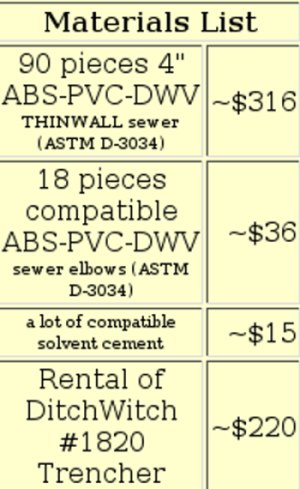
was an emergency situation. The time and energy a Ditch Witch can save
is what makes this project practical.

Or explore more posts by date or by subject.
About us: Anna Hess and Mark Hamilton spent over a decade living self-sufficiently in the mountains of Virginia before moving north to start over from scratch in the foothills of Ohio. They've experimented with permaculture, no-till gardening, trailersteading, home-based microbusinesses and much more, writing about their adventures in both blogs and books.
Want to be notified when new comments are posted on this page? Click on the RSS button after you add a comment to subscribe to the comment feed, or simply check the box beside "email replies to me" while writing your comment.
The guys who wrote the articles you referred to actually seem to know what they were talking about. How refreshing.
Personally, I'd probably go for a water-filled system to prevent condensation and mold problems. An extra heat exchanger is a one-time expense, and your health is something you cannot buy. Problems with mold are very hard to get rid of. An additional possible problem with an air-filled system might be ground water infiltration (you seem to have quite wet soil?). Keep your tubes well away from trees, or you might find that tree roots are invading your pipes in a couple of years!
I like their idea of drawing outside ventilation air through an undergrond pipe to pre-heat it in the winter or pre-cool it in the summer.
And you could do something similar to your furnace. My new gas-powered heater uses a double concentric pipe, 110 mm outer diameter, 80 mm inside diameter. The inner pipe is used to expel the exhaust gasses. As the inner pipe heats up, it pre-heats the air flowing from the outside to the furnace. This has the additional advantages that the furnace does not consume air from the inside of the house and that it therefore cannot spew back flue gasses into the house. Without a fan it is important to keep the pipes short and without bends. I've been told every 90 degree bend equals about a yard in pipe length with this pipe. The size used in my flat has been optimized for a has heater which uses a blower to expel the flue gasses. For furnaces without forced ventilation different pipe sizes are available.
As long as you keep the pipe diameter constant, there will be no Bernoulli effect. Or we are talking about two different things?
To get good flow, you'll need a lot of pipes in parallel. It is important to give all of these the same length, and that they have the same number of elbows in them. More length of one of the pipes (or more elbows) means more resistance in that pipe, and so less flow in that pipe.
Another thing is to bury the pipes below the frost line, lest freezing groundwater crush your pipes! Not sure what that is in your neck of the woods, but for Minnesota it is 3.5 to 5 feet. Look in your state's building code for required foundation depth. Anything below that should be fine. Definitely Ditch Witch territory, in any case. You might want to encase the sections of pipe that have to penetrate the frost line in concrete to protect them.
The problem with all these kinds of systems is that the smaller the temperature difference between the air and the soil, the less heat is transferred. That's basic physics. And air is a poor working fluid for heat transfer.
And for such a system to be useful as a heater in winter, you'll need a heat pump to get your house warmer than ground temperature...
Good insulation OTOH would reduce both your cooling and heating needs, depending on the season. Maybe you should (long term) look into building an Earthship?
Roland --- I'm so glad to get your feedback on this, and I'm glad to hear that site has your seal of approval. Very good info about the bends, pipe lengths, etc.
Thanks for taking on Daddy's comment too. All I remember about the Bernoulli effect from high school physics is umbrellas turning inside out.
We've considered earthships (and other underground structures), but our groundwater is really, really high. Mark does dream of building a little underground house in the side of the hill, which might have lower groundwater, we hope...
An earthship is just a fancy name for an earth-insulated house built as much as possible with reclaimed materials. it doesn't have to be underground!
Unless you fancy a lot of shovelling, I'd recommend hiring a backhoe loader. When you're driving that you won't much care if you are excavating a hillside of building an artificial hill.
There's this Hobbit hole in the UK that'd be right up your alley, I think. Cheap too, as houses go.
I saw another version built out of huge elliptical sewer pipes covered with earth, but I can't find that website just now. It has all the technical bits (plumbing, heating, electrics) hidden under floors laid in the pipes. Out of the way yet accessible.
I didn't realize earthships could be aboveground!
I ran across that Hobbit Hole once before. I think it's the prettiest house I've ever seen (which gives you a bit of an idea of what I think is pretty. )
)
Mark stumbled across a site somewhere that had built a house out of a culvert. We liked the idea, but the thought of trying to get a huge concrete culvert back here seemed like a pipe dream.
Radon is pretty much everywere on land. It is responsible for a large part of the background radiation we experience daily, and has been throughout the course of human evolution. Our bodies have pretty much adapted to cope with it. (see radiation hormesis).
And for the radon to get into the air in the geothermal system, it would have to penetrate the pipe walls. Since it seems that radon enters houses mostly through cracks and gaps, it doesn't look like it will permeate into the pipes.
If your trailer is leaky enough to ventilate well, I don't think you'd have to worry about radon buildup.
It is another reason to avoid air-filled cooling systems, but hardly the only one. To start with the fact that air is a pretty poor heat transfer medium. And in your waterlogged soil, any leak in the pipe system will mean groundwater ingress into the system. Combined with the inevitable condensation, this will need draining. Since the air flowing through the system will also bring in organic material, it could be a nice spot to grow bacteria and molds.